- Company
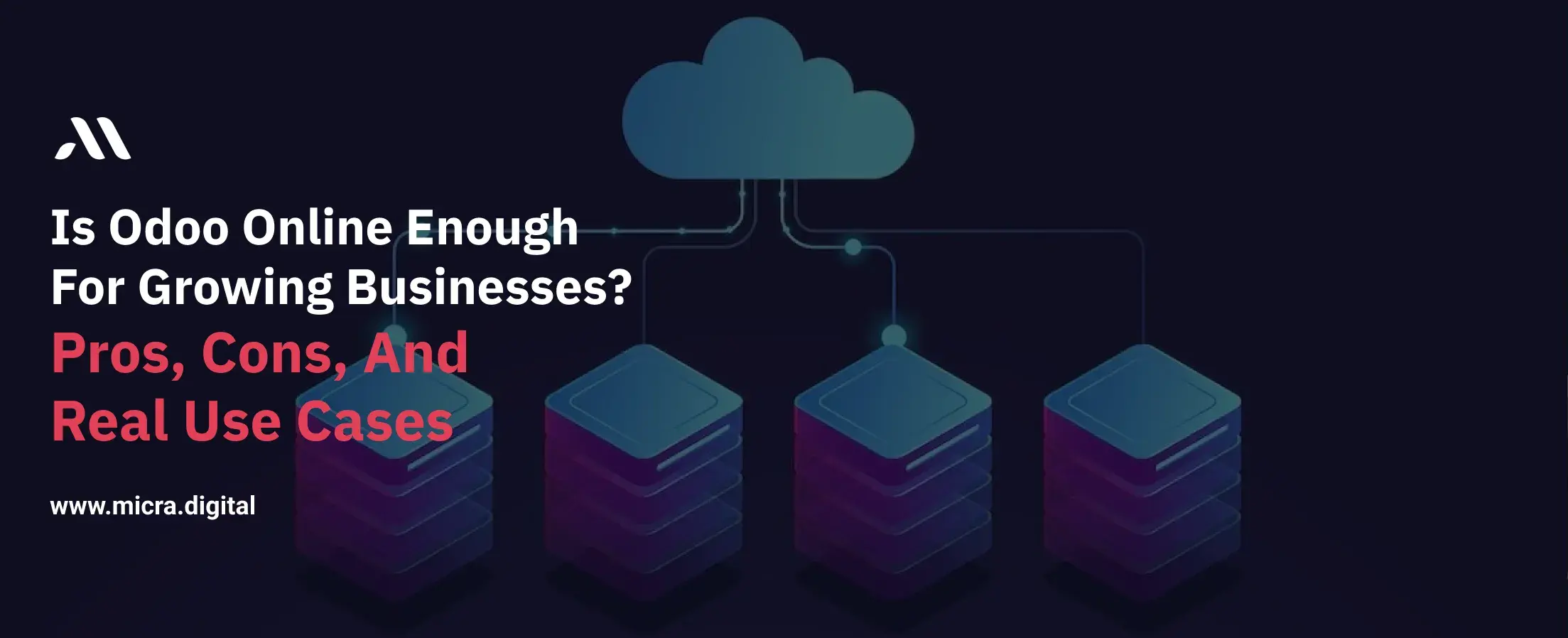
A good business starts small, but a great business plans for growth. As a business owner, you know that the software you choose today will have a big impact on your future.
For many businesses, the journey begins with Odoo Online, a popular cloud-based version of the powerful ERP system. It is easy to use, affordable, and seems to have everything a small business needs.
But as a business grows, a question arises: Is Odoo Online still enough? The answer is not a simple yes or no. The right choice depends on your specific needs, your industry, and your long-term goals.
This in-depth blog post will examine the advantages, disadvantages, and practical applications of Odoo Online for growing businesses.
Also Read: Why Modern Leaders See Odoo ERP as Their Second Brain
Odoo Online is the cloud-hosted version of Odoo. It is managed directly by Odoo’s team, which means you don’t need to worry about servers, updates, or hosting costs.
Unlike Odoo.sh or on-premises setups, Odoo Online has limitations in terms of customizations, but it is often the first step for many businesses exploring the Odoo ERP platform.
Odoo Online is enough when:
You need Odoo.sh or On-Premise when:
.jpg)
Odoo Online has a lot to offer, especially for a small business. Its benefits are often the reason why many new businesses choose it as their first ERP.
1. Ease of Use and Fast Setup: You can get started with Odoo Online in minutes. There's no complex installation process. You just sign up and start using the apps you need. This is a huge benefit for a small business owner who doesn't have a big IT team. The user interface is clean and easy to understand, which makes it easy for your staff to learn.
2. Lower Initial Cost:The cost of Odoo Online is based on a per-user, per-month model. You only pay for the apps you use. This makes it a very affordable option for a small business that doesn't need all the features of a full ERP. It's a great way to test the waters and see if an ERP is the right choice for your business.
3. No Maintenance: Since Odoo Online is hosted and managed by Odoo, you don't have to worry about updates, security, or server maintenance. This frees you up to focus on what you do best, running your business. This is a key reason why many small businesses choose this ERP system.
4. Regular Updates:Odoo Online is always updated to the latest version. You get access to new features and improvements as soon as they are released. This ensures that you are always working with the best ERP system and the latest Odoo software.
While Odoo Online is a great starting point, it has some limitations that can become a problem for businesses as they grow. These limitations often lead growing businesses to look for other options, such as Odoo On-Premise or Odoo.sh.
1. Limited Customization: Odoo Online does not allow for a lot of customization. You cannot add custom code, change the underlying database, or integrate with other software that is not in the Odoo App Store. For a growing business with unique needs, this can be a big problem. A manufacturing business, for example, might need a custom report that is not in the system. The Odoo ERP is a powerful tool, but its online version has limits.
2. No Third-Party Integration: If you use a third-party software that is not in the Odoo App Store, you cannot connect it to Odoo Online. For a business that uses a specific accounting software or a special marketing tool, this can be a major issue. This is a key reason why many ERP software companies recommend a more flexible version of the ERP.
3. Performance Limits: As your business grows and your data becomes bigger, you might find that Odoo Online becomes slower. This is because you are sharing the same server with many other businesses. This can affect the speed of your operations and can cause a lot of frustration. This is a key issue that a modern ERP helps with.
4. No Control:With Odoo Online, you don't have any control over the server or the database. You are completely dependent on Odoo for everything, from security to updates. For a business that needs more control over its data, this can be a major issue. A full Odoo ERP gives a business owner more control.
A retail chain with three outlets used Odoo Online for POS, inventory, and invoicing. It helped them monitor stock in real time. However, as they expanded to 10 stores, they had to move to Odoo.sh for custom POS reporting.
A small restaurant used Odoo Online for table management, sales, and expenses. It worked perfectly until they wanted third-party delivery integrations like Swiggy and Zomato. At that point, they needed Odoo.sh.
A training institute started with Odoo Online to manage student enrollments and payments. Later, they wanted a custom attendance system and LMS (Learning Management System) integration, which pushed them toward On-Premise Odoo ERP.
A single-location clinic used Odoo Online to manage patients and billing. But as they grew into a multi-specialty hospital, they needed features like lab integrations and insurance claim management. That required migration to Odoo.sh.
A small furniture manufacturer used Odoo Online for inventory and invoicing. When they wanted advanced MRP (Manufacturing Resource Planning), they had to switch to on-premises for deeper control.
Choosing the right ERP is one of the most important decisions you will make for your business. Don't let the limitations of Odoo Online hold you back. If you are a growing business, you need an ERP that can grow with you.
At Micra Digital, we specialize in helping businesses like yours implement and configure the right Odoo ERP system. We will work with you to create an ERP solution that not only meets your needs today but also helps you achieve your goals for tomorrow.
Yes, Odoo Online is a real ERP. It provides all the core features of a modern ERP, but it has some limitations on customization and third-party integrations.
Yes, you can. You can export your data from Odoo Online and import it into another version of Odoo, like Odoo On-Premise or Odoo.sh.
Odoo Online is hosted and managed by Odoo. Odoo On-Premise is hosted on your own server. With Odoo On-Premise, you have more control over the system, but you also have to manage the server and the updates.
Micra Digital offers consultation, setup, customization, and ongoing support to ensure Odoo fits your business operations smoothly.
Let Odoo take your business to the next level!
Contact us and take the next step!
Follow Our Adventures!

Ready to launch your next project?
Company
Copyright © 2020. micra.digital. All rights reserved.