- Company
The way businesses operate is changing fast. Factories, restaurants, schools, and hospitals are no longer just physical spaces, they’re becoming interconnected hubs of data and automation.
At the heart of this shift is the Internet of Things (IoT), a technology that connects devices, sensors, and machines to the internet, allowing them to "talk" to each other and to software systems like Odoo. For industries like manufacturing, retail, healthcare, and more, IoT Integration with Odoo isn’t just a trend—it’s the foundation of a smarter, more efficient future.
In this blog, we’ll explore how IoT Integration with Odoo is transforming operations, reducing costs, and paving the way for the future of smart manufacturing and beyond.
Also Read: Odoo Approvals to Automate & Speed Up Business Operations
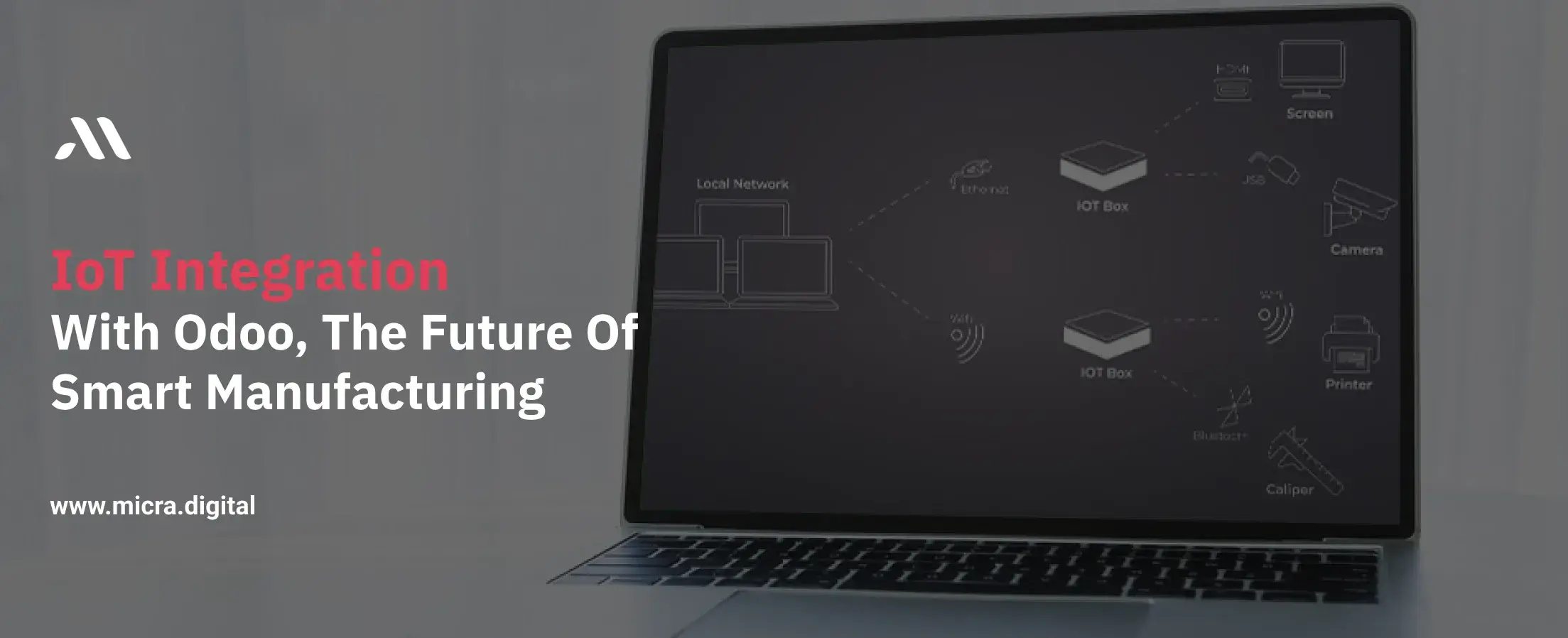
IoT Integration with Odoo refers to connecting IoT devices (like sensors, cameras, or machinery) to the Odoo ERP platform. This allows real-time data from these devices to flow directly into Odoo, automating tasks, improving decision-making, and creating a seamless link between physical operations and digital management.
For example, imagine a manufacturing plant where sensors on production lines monitor machine temperatures. With IoT Integration with Odoo, this data is sent to Odoo’s dashboard. If a machine overheats, Odoo automatically alerts the maintenance team, creates a work order, and adjusts production schedules, all without manual input.
Here are a few common IoT devices that connect easily with Odoo:
Why does this matter?
The future of smart manufacturing relies on three pillars: connectivity, automation, and data-driven decisions. IoT is the glue that binds these elements together. Here’s how:
1. Predictive Maintenance: Instead of waiting for machines to break down, IoT sensors predict failures before they happen.
2. Supply Chain Transparency: Track raw materials from supplier to factory floor in real time.
3. Energy Efficiency: Monitor and optimize power usage across facilities.
AMcKinsey reportestimates that IoT-driven predictive maintenance can reduce equipment downtime by 50% and cut maintenance costs by 25%. For manufacturers, this means fewer delays and higher productivity, key factors in the future of smart manufacturing.
 (1).jpg)
Here’s how this integration can transform your manufacturing setup:
Sensors installed on machines can send live data to Odoo dashboards. This includes temperature, speed, pressure, and machine health. Managers no longer have to wait for reports; they can see problems as they happen.
Tip: Use IoT dashboards in Odoo to spot abnormal machine behavior early, avoiding costly breakdowns.
Instead of waiting for a machine to fail, IoT data helps predict when it’s likely to break. Odoo can automatically schedule maintenance based on machine performance, not guesswork.
Remember: A small fix today can prevent a big expense tomorrow.
According to Deloitte, predictive maintenance can reduce equipment breakdowns by up to 70% and cut maintenance costs by 25%
IoT sensors can inspect products in real time. If something’s off, Odoo logs the data, alerts quality teams, and even triggers corrective actions.
Note: This reduces human error and increases production consistency.
With IoT-enabled shelves, bins, and pallets, Odoo gets live updates on stock levels. The system can auto-reorder materials when they run low, avoiding overstocking and understocking.
Quote: “If you can't measure it, you can't manage it.” – Peter Drucker
When your Odoo system is constantly fed fresh data from IoT devices, your decision-making becomes faster and more accurate. You see what’s happening right now, not what happened last week.
Manufacturers face constant pressure to cut costs and meet tight deadlines. IoT Integration with Odoo tackles these challenges head-on:
Stat: Factories using IoT and ERP integration report a 30% increase in production efficiency (Gartner).
Tip: Start with one critical process (e.g., machine maintenance) before scaling IoT across your facility.
Restaurants can use IoT Integration with Odoo to manage perishable inventory and enhance customer experiences:
Retailers use IoT to bridge online and offline shopping:
Stat: Retailers using IoT see a 20% boost in sales due to better inventory management (Retail Dive).
Schools and universities benefit from IoT in campus management:
Note: Ensure student data privacy by using secure IoT devices and Odoo’s access controls.
Hospitals and clinics use IoT Integration with Odoo to improve patient care:
Stat: Healthcare providers using IoT reduce equipment downtime by 35% (Deloitte).
Solution: Phase investments over time. Begin with low-cost sensors.
Solution: Use Odoo’s reporting tools to focus on key metrics.
Solution: Partner with Odoo-certified IoT specialists.
The future of smart manufacturing will see IoT and Odoo working together in even smarter ways:
IoT integration with Odoo isn’t just a fancy tech trend, it’s a powerful way to rethink how your business runs. Whether you're trying to reduce machine downtime, keep better track of inventory, or simply stay ahead in your industry, this integration gives you the tools to do it.
And as the future of smart manufacturing unfolds, those who adapt early will see the biggest rewards.
Start with one machine. See the change. Then scale.
Micra Digital can help embrace the future of smart manufacturing. Let’s Talk.
Not necessarily. Many IoT platforms offer ready APIs or modules that connect with Odoo. Hiring a tech partner can make the process easier.
Yes, in many cases. You can attach external sensors or use smart controllers to bridge the gap between old hardware and new systems.
It depends on the scale. Starting small is very affordable. Over time, the cost is recovered through reduced downtime and better productivity.
Odoo can integrate with pressure sensors, temperature sensors, motion sensors, barcode readers, RFID tags, and more using connectors or custom modules.
Yes. Real-time data capture and automated updates in Odoo reduce the need for manual entry and significantly reduce the chances of human error.
Let Odoo take your business to the next level!
Contact us and take the next step!
Follow Our Adventures!

Ready to launch your next project?

Company
Copyright © 2020. micra.digital. All rights reserved.