How Odoo ERP Optimizes Production in the Foundry Industry.
The foundry industry, a foundational pillar of manufacturing, is built on transforming raw metals into precision components through the intricate process of casting. From the roaring furnaces melting metal to the meticulous steps of molding, pouring, cooling, and finishing, every stage in a foundry's operation is a complex dance of materials, machinery, and skilled labor.
For foundry owners around the world, the challenges are significant: managing volatile raw material costs, ensuring consistent quality, optimizing energy consumption, and delivering on time in a competitive global market.
To truly excel, foundries need a unified, intelligent system that provides real-time visibility and control across their entire production lifecycle. This is precisely where an Enterprise Resource Planning (ERP) system proves invaluable.
An ERP system acts as the central brain of a foundry, connecting all departments and processes into a single, cohesive platform. This detailed blog will explore how Odoo, a versatile and powerful open-source ERP, can specifically optimize production in the foundry industry.
Also Read: ERP software for Ceramic Manufacturers. Reducing Waste, Maximizing Profit.
The Role of ERP in Foundry Operations
An ERP system integrates various business processes, providing a unified platform for data management and operational control. For foundries, this means:
- Centralized Data:Real-time access to information across departments.
- Process Automation: Reducing manual interventions and errors.
- Enhanced Decision-Making: Data-driven insights for strategic planning.
Understanding the Foundry Industry's Challenges
Operating a modern foundry involves navigating a multitude of complexities. Understanding these challenges is the first step towards recognizing how an effective ERP can provide solutions:
- Raw Material Volatility: The cost and availability of metals like iron, steel, aluminum, and alloys can fluctuate significantly, impacting production costs and profitability.
- Complex Bill of Materials (BOMs): Castings often require intricate BOMs that include metals, sand, binders, coatings, and fluxes, demanding precise material planning.
- Process Variability: Factors like melt temperature, pouring speed, cooling rates, and humidity can affect casting quality, leading to high rejection rates if not controlled.
- High Energy Consumption: Melting metal is energy-intensive, making energy efficiency a critical factor for cost control and environmental responsibility. According to JML Industrie, optimizing energy consumption with innovative equipment and reducing CO2 emissions through more efficient furnaces are major environmental challenges for the foundry industry.
- Quality Control and Traceability: Ensuring each casting meets stringent specifications and tracing a defective batch back to its raw materials and production parameters is essential.
- Equipment Maintenance: Furnaces, molding machines, and other heavy equipment require regular, often specialized maintenance to prevent costly downtime.
- Waste Management: Foundries generate significant amounts of waste, including spent foundry sand, slag, and dust. Efficient management and potential recycling are crucial. Waste foundry sand (WFS) is a major byproduct, with about 0.6 tons produced per 1 ton of foundry production.
- Skilled Labor Shortages: The foundry industry often faces challenges in attracting and retaining skilled workers who understand complex casting processes.
- Global Competition: Foundries must remain competitive against international players, necessitating efficient operations and cost-effective production.
The global foundry industry market reached $62.16 billion in 2023 and is projected to reach $105.03 billion by 2032, with a compound annual growth rate (CAGR) of 6.0%. (Source: JML)
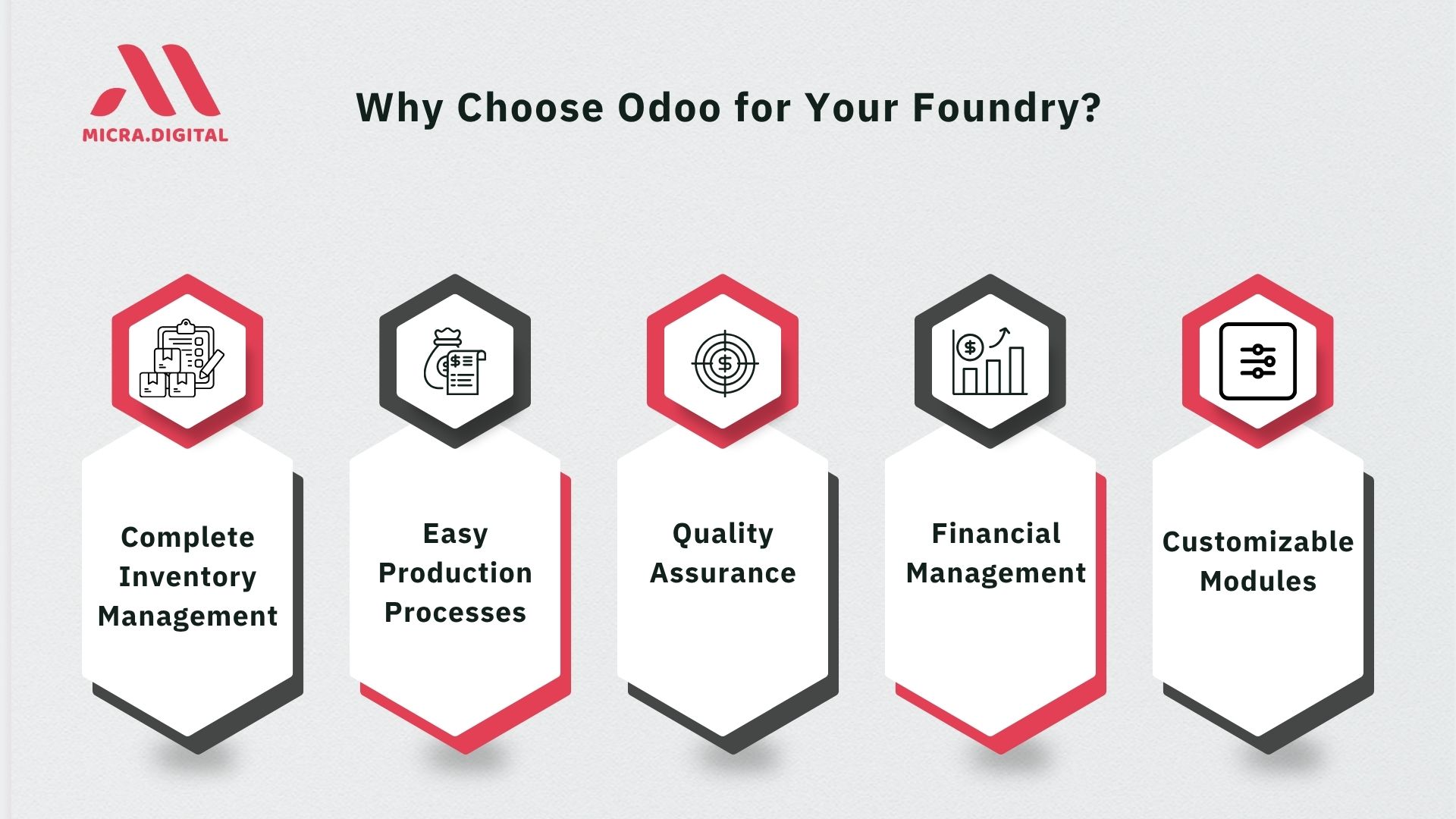
Odoo ERP: Forging a Path to Production Excellence in Foundries
Odoo, a leading ERP system, is celebrated for its modular design and open-source flexibility. This makes it an excellent choice for the foundry industry, as it can be adapted to specific processes and scaled as the business grows. Let's explore how Odoo ERP optimizes production:
1. Easy Production Planning and Control with Odoo:
At the core of efficient foundry operations is precise planning. Odoo ERP provides comprehensive tools for production management, allowing foundries to move beyond reactive operations to proactive planning.
- Dynamic Bill of Materials (BOM): Odoo ERP enables the creation of detailed, multi-level BOMs that accurately define all raw materials, components, and sub-assemblies needed for each casting. This includes specific metal compositions, sand types, binders, and even consumables like risers and gates.
- Work Order Management:Generate work orders directly from sales orders or production forecasts. Odoo ERP allows for granular tracking of each work order through its various stages, from molding and core making to melting, pouring, cooling, fettling, and final inspection.
- Routing and Workcenter Management: Define the sequence of operations (routings) and assign them to specific workcenters (e.g., induction furnace, molding line, sand preparation area, shot blasting unit) within the ERP system.
- Capacity Planning:Odoo ERP helps in visualizing workcenter loads and identifying potential overloads or underutilization. This allows managers to make informed decisions about resource allocation, overtime, or even investment in new equipment, ensuring production targets are met without straining resources.
- Shop Floor Data Capture: With Odoo software, data from the shop floor can be captured in real-time through tablets or integrated systems. Operators can record production quantities, consumed materials, and downtime, providing immediate feedback into the ERP system for accurate progress tracking and performance analysis.
2. Intelligent Inventory and Material Traceability with Odoo:
Managing diverse raw materials, work-in-progress, and finished castings is a major challenge. Odoo ERP provides a powerful inventory management software solution.
- Real-Time Stock Overview: Gain complete visibility into your inventory levels across all locations – from raw material yards and sand storage to WIP areas and finished goods warehouses. Odoo ERP updates inventory in real-time as materials are consumed in production or products are shipped.
- Batch and Lot Tracking: Critical for quality control and recalls in the foundry industry. Odoo ERP allows for detailed tracking of each batch of raw materials (e.g., specific melts of scrap metal, incoming chemical binders) and finished castings.
- Automated Reordering: Set up minimum and maximum stock levels for your raw materials and consumables within the ERP system. Odoo ERP can automatically generate purchase orders when stock falls below a set threshold, preventing costly production delays due to material shortages.
- Waste and Scrap Management: Accurately track generated waste (e.g., spent sand, slag, rejected castings) within Odoo software. This data is vital for analyzing waste sources, identifying areas for improvement, and potentially exploring recycling opportunities to reduce environmental impact and costs.
- Supplier Management:Manage supplier information, purchase agreements, and delivery schedules directly within Odoo ERP. This helps ensure the timely arrival of raw materials at competitive prices, reducing disruptions to the foundry industry's production flow.
3. Enhanced Quality Control and Inspection with Odoo:
Quality is non-negotiable in the foundry industry. Odoo ERP helps embed quality checks throughout the entire production process.
- Defined Quality Control Points: Set up mandatory quality control steps at various stages in your production routing within the ERP system. This could include raw material inspection, pre-pour checks, post-casting inspection, and final dimensional checks.
- Inspection Records: Operators can record inspection results directly into Odoo software, capturing details like temperature readings, chemical compositions (e.g., from spectrometer integrations), dimensional measurements, and visual defect observations.
- Non-Conformance Management: If a casting doesn't meet quality standards, Odoo ERP allows for flagging non-conforming products, initiating a clear workflow for rework, scrap, or further analysis. This helps in understanding defect causes and reducing future rejections.
- Statistical Process Control (SPC): While Odoo itself provides robust reporting, it can be extended or integrated to support SPC methods, allowing for the analysis of quality data trends to predict and prevent future issues.
4. Proactive Maintenance Management with Odoo:
Unplanned downtime of critical foundry equipment (furnaces, molding machines, shot blasters) can bring production to a grinding halt, leading to massive losses. Odoo ERP includes a dedicated Maintenance module.
- Preventive Maintenance Scheduling:Schedule routine maintenance based on time or usage (e.g., after X hours of furnace operation). This proactive approach minimizes unexpected breakdowns, extends equipment lifespan, and reduces repair costs.
- Corrective Maintenance: When a breakdown occurs, quickly create maintenance requests, assign them to technicians, and track their progress within Odoo software.
- Spare Parts Inventory: Manage your spare parts inventory directly within the ERP system. Link spare parts to specific equipment, ensuring critical components are always available when needed, further reducing downtime.
- Maintenance History:Maintain a detailed history of all maintenance activities for each piece of equipment. This data helps in identifying recurring issues and making informed decisions about equipment replacement or upgrades.
5. Financial Visibility and Profitability Analysis with Odoo:
Ultimately, all operational improvements driven by Odoo ERP translate into financial gains.
- Accurate Costing: With precise data from production management and inventory management, Odoo ERP provides accurate cost calculations for each casting, including raw materials, energy, labor, and overheads. This detailed costing is crucial for competitive pricing and understanding actual profit margins.
- Improved Cash Flow: Better inventory management (reducing excess stock) and faster production cycles lead to improved cash flow for the foundry industry.
- Enhanced Reporting and Analytics:Odoo ERP offers a wide range of standard and customizable reports. Analyze key performance indicators (KPIs) related to production efficiency, waste rates, material consumption, and profitability. This data empowers foundry owners to make data-driven decisions that directly impact the bottom line.
Conclusion
Implementing Odoo ERP in the foundry industry addresses critical operational challenges, leading to improved efficiency, quality, and profitability. With the right partner like Micra Digital, the transition to a more integrated and automated system becomes a strategic move towards sustainable growth.
FAQ’s
1. Is Odoo suitable for small to medium-sized foundries?
Yes, Odoo's modular design makes it adaptable for businesses of all sizes.
2. How long does it take to implement Odoo in a foundry?
Implementation time varies but typically ranges from 3 to 6 months, depending on complexity.
3. Can Odoo integrate with existing systems?
Yes, Odoo can be integrated with various third-party applications and systems.
4. What kind of support does Micra Digital offer post-implementation?
We provide ongoing support, including system updates, troubleshooting, and training.
5. Is data migration from old systems to Odoo possible?
Absolutely, we assist in migrating data securely and efficiently.