- Company
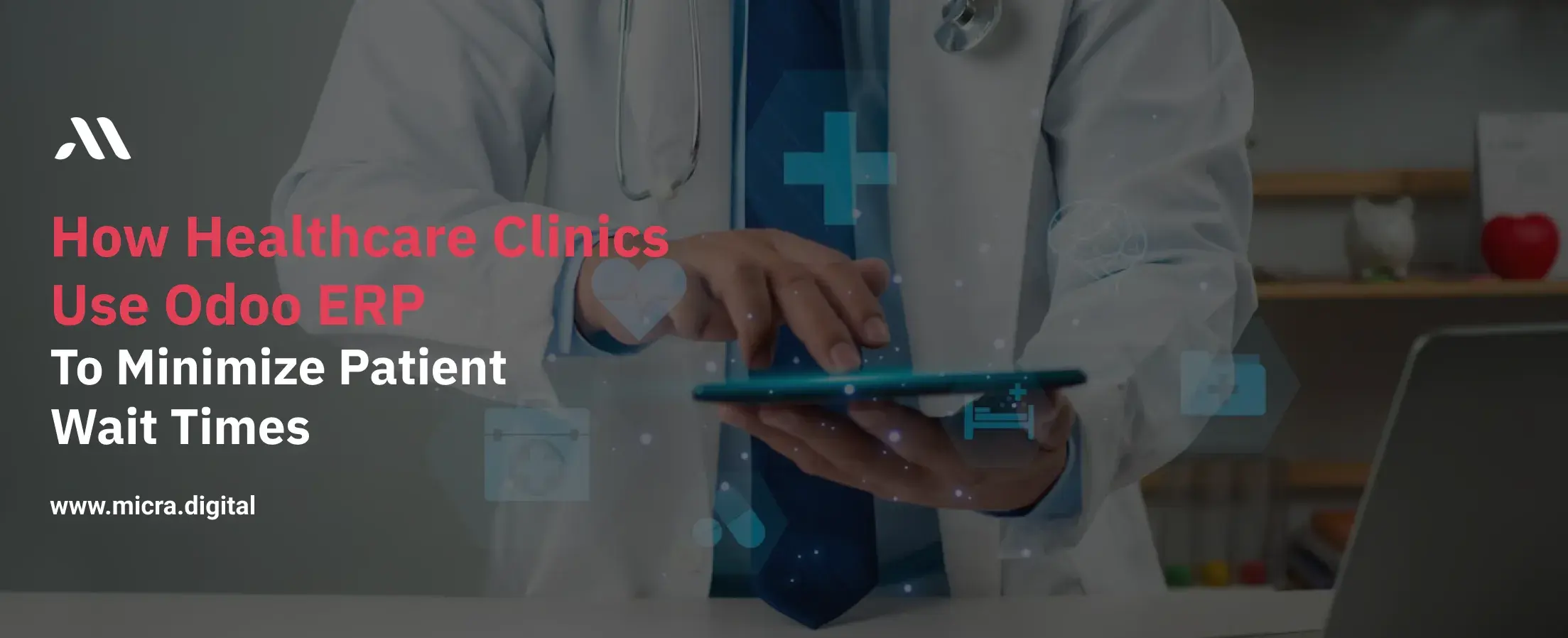
Long waits frustrate patients and staff, negatively impact patient satisfaction, and compromise clinic efficiency. For clinic owners and managers, reducing wait times is one of the most effective ways to enhance patient experience and improve clinic performance.
Today, many clinics are using modern tools to manage appointments, staff, inventory, and records, and one of the most practical platforms for that work is Odoo ERP for healthcare operations.
This guide explains how Odoo and an ERP approach help clinics cut waiting times at every touchpoint from booking to reception to the doctor’s room and aftercare with concrete examples, statistics, tips, and practical steps you can apply in your clinic.
Also Read: Odoo ERP as Your Business GPS: Navigating Growth with Real-Time Data
Many healthcare clinics operate in a fragmented way. Their front desk staff uses a calendar to book appointments, but the doctors use a separate system to view patient records. The billing department has its own software to create invoices. This separation creates a number of problems that directly affect the patient.
These problems can cause a lot of frustration for patients and can also cost a clinic a lot of money in wasted time. A modern ERP is the best ERP software for any clinic that wants to solve these problems.
.jpg)
An Odoo ERP is a complete enterprise resource planning system that is designed to unify a business's front-end and back-end operations. It is a single platform with a set of integrated apps that are designed to work together.
This is a key reason why many consider Odoo the best ERP software for healthcare. With an Odoo ERP, all your patient data is in one place and is updated in real time. This gives you a clear, 360-degree view of your entire operation and helps you make a patient's journey much smoother.
Here are some real-world examples of how an Odoo ERP can help a healthcare clinic.
The patient experience starts with the first contact. A patient might look for a clinic online and then call to book an appointment. A good ERP makes this process easier.
In a fragmented system, a patient's information is in different places. This can lead to a lot of confusion and wasted time. A unified ERP solves this problem.
According to a report by the Healthcare Information and Management Systems Society (HIMSS), 92% of healthcare organizations believe that a connected ERP is essential for providing a good patient experience.
Billing and payments are a crucial part of a clinic’s operations. A manual process can lead to a lot of errors and delays. A good ERP can help with this.
A clinic needs a lot of supplies, from medical equipment to cleaning supplies. A fragmented system can lead to a lot of problems with inventory. A good ERP can help with this.
Pitfall: Rigid schedules that don’t reflect reality.
Solution: Use actual data from Odoo dashboards to set realistic appointment slots.
Pitfall: Poor reminder strategy.
Solution: Test multiple reminder timings and channels (SMS, email) by monitoring no-show changes.
Pitfall: Ignoring telemedicine.
Solution: Use teleconsults for follow-ups and routine checks to free in-clinic capacity.
Pitfall: Not involving clinical staff in design.
Solution: Engage doctors and nurses in workflow design so the system supports real clinical practice rather than forcing new inefficiencies.
Are you tired of long patient wait times and a disconnected system? It's time to get a clear view of your clinic's operations and provide a better patient experience.
At Micra Digital, we specialize in helping healthcare clinics implement and configure an Odoo ERP system. We will work with you to create an ERP solution that not only makes your operations more efficient but also helps you provide a great patient experience.
No. The modular design of a platform like Odoo makes it a great ERP solution for clinics of all sizes. You can start with just a few apps and add more as you grow.
Basic training for reception and clinicians (one or two sessions) is usually enough to get started. More advanced users (managers) benefit from learning the dashboards and reporting more deeply.
Odoo supports role-based access, encrypted connections, and standard security practices. Implementers should configure user roles, audit logs, and data backup as part of the deployment.
An ERP can help a clinic with its inventory by giving it a real-time view of its stock levels. This prevents a clinic from running out of a key supply and helps it make better decisions about when to order more.
A cloud-based ERP, like Odoo, is often a better choice for most businesses. It is more affordable, easier to maintain, and can be accessed from anywhere in the world.
Let Odoo take your business to the next level!
Contact us and take the next step!
Follow Our Adventures!

Ready to launch your next project?
Company
Copyright © 2020. micra.digital. All rights reserved.