- Company
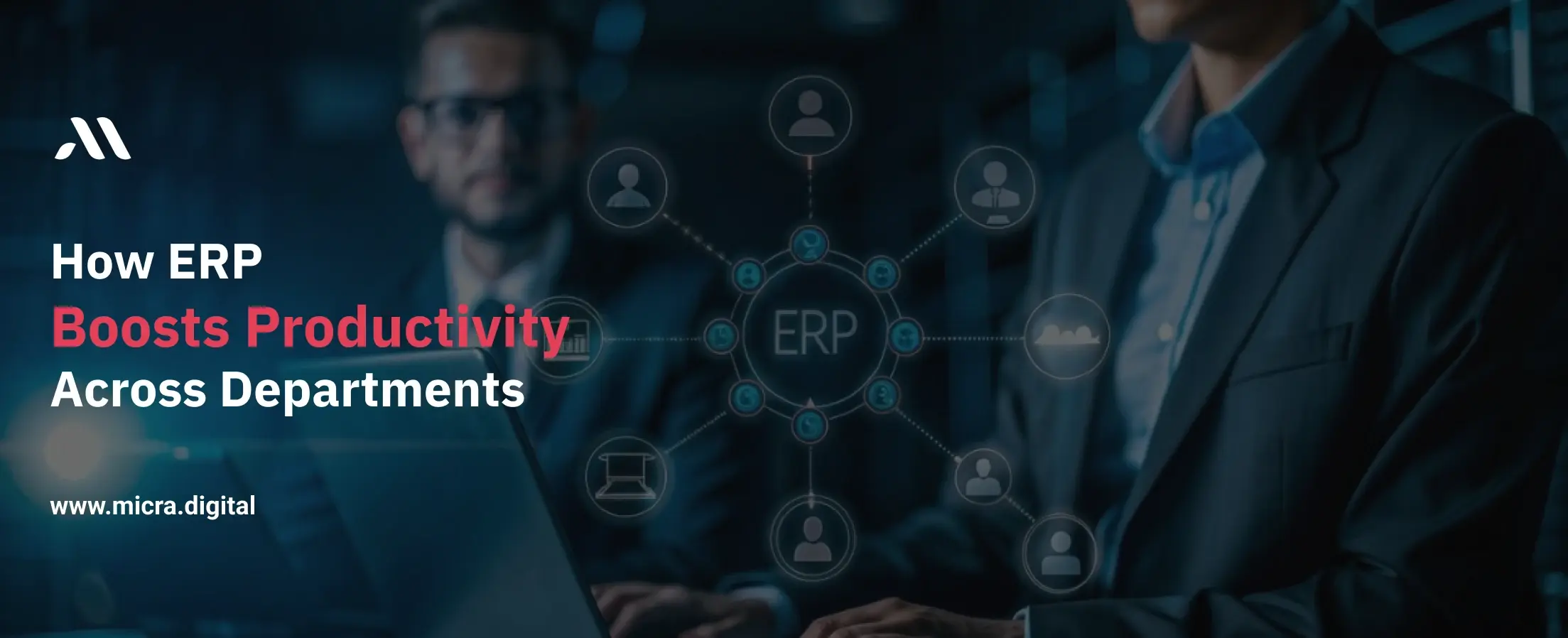
Every business has multiple departments, including finance, HR, sales, inventory, production, and customer service, all of which perform critical tasks daily. But when each team uses its own software or spreadsheets, information gets scattered. That’s where ERP (Enterprise Resource Planning) steps in.
An ERP system connects all departments on a single platform, enabling them to share data, collaborate, and make informed decisions more efficiently. It creates a single source of truth for the entire organization.
Also Read: How ERP Helps You Manage Remote Teams Effectively
At the heart of an ERP lies a centralized database.
Instead of each department maintaining separate records, everyone accesses and updates information in real time.
For example:
All of this happens without manual data entry or back-and-forth emails because all departments are connected through the ERP.
.jpg)
Let’s look at how this connection works across different business areas
The finance department acts as the backbone of every business. With ERP, financial data is directly linked to operations.
This means finance always sees accurate numbers without waiting for reports from other teams.
In a manufacturing company, ERP connects production schedules with supply chain and inventory data.
This end-to-end visibility helps reduce delays and improve output.
HR connects with other departments through ERP by syncing employee data, attendance, and payroll with operations.
So HR decisions are based on real, department-level data, not assumptions.
ERP unifies inventory with sales, purchases, and production.
This ensures that the right materials are available at the right time without manual coordination.
Sales and CRM teams work directly with ERP to ensure smooth order processing.
Customers get faster responses, and departments stay aligned on every sale.
Procurement connects with finance, inventory, and production through ERP.
Every purchase decision is transparent and traceable across departments.
For leaders and managers, ERP provides a complete bird’s-eye view of all departments.
Dashboards display live data from every unit: sales, HR, production, and finance in one place.
This means:
Faster information flow- no waiting for updates.
Fewer errors - data entered once, used everywhere.
Better collaboration - everyone works from the same dashboard.
Improved customer experience - faster response and accurate order tracking.
Real-time visibility - managers can act immediately when issues arise.
ERP improves productivity by automating repetitive processes like:
Automation reduces human error and frees up time for strategic work. It also ensures that data flows instantly between departments, eliminating communication gaps.
Example:
When sales record an order, ERP automatically updates inventory, triggers a purchase if needed, and sends data to accounts for invoicing; all without manual effort.
Implementing an ERP system can feel like a big step, but the returns are measurable.
According to Nucleus Research (2023),Companies earn an average of $7.23 for every $1 spent on ERP implementation.
That ROI comes from:
An ERP doesn’t just automate tasks; it builds bridges between departments. Finance talks to operations, sales syncs with inventory, HR connects with payroll; all within one ecosystem.
If your business still runs on separate software, it’s time to bring everything together. A connected ERP system like Odoo can transform confusion into coordination.
At Micra Digital, we help businesses unify their operations using Odoo ERP, customized to your workflow, industry, and team structure.
ERP automates daily processes, centralizes data, and reduces manual errors, allowing departments to work faster and make informed decisions.
Odoo ERP is one of the best systems for SMEs; it’s modular, affordable, and easy to customize for different industries.
Most businesses notice efficiency improvements within 3–6 months of ERP implementation, especially after employee training.
Micra Digital provides custom ERP development, integration, and automation services, helping you achieve real productivity gains without technical headaches.
Let Odoo take your business to the next level!
Contact us and take the next step!
Follow Our Adventures!

Ready to launch your next project?

Company
Copyright © 2020. micra.digital. All rights reserved.