
Home / Blog / How AI is Changing the Manufacturing Industry: Automation and Innovation Explained

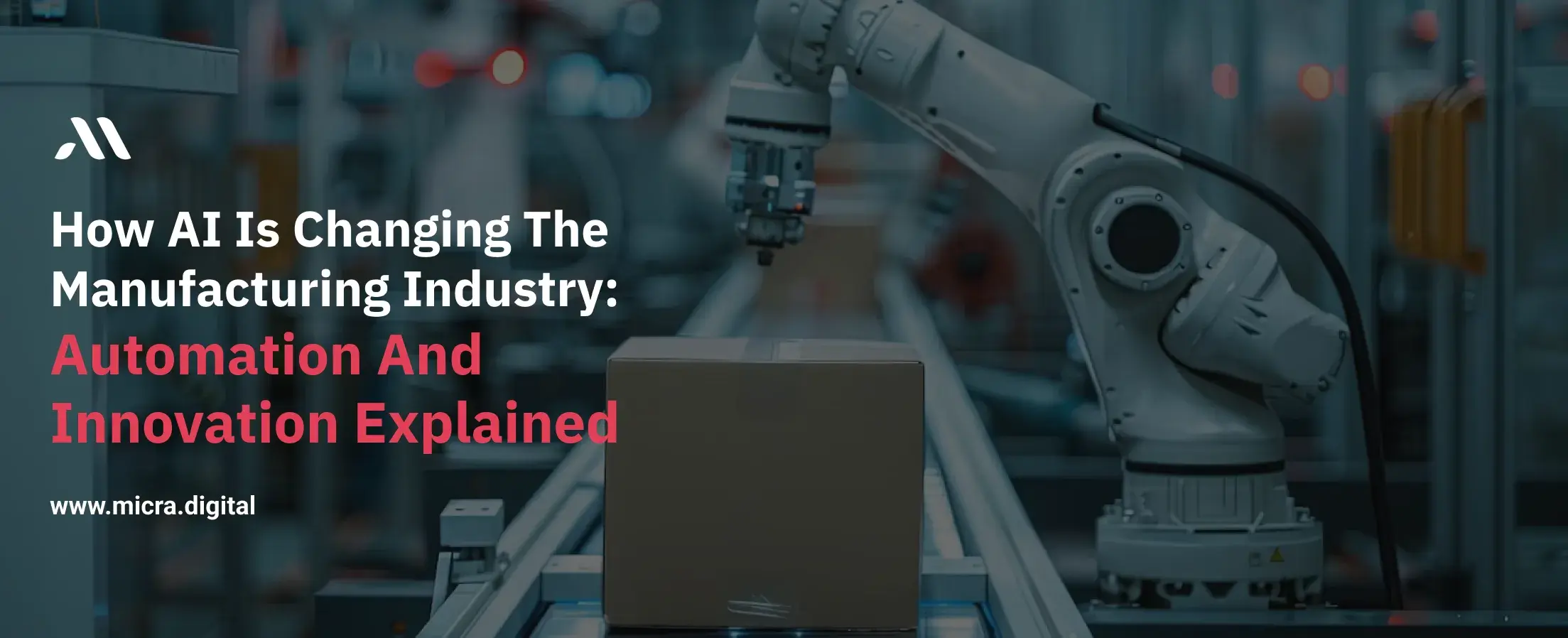
How AI is Changing the Manufacturing Industry: Automation and Innovation Explained

How AI is Changing the Manufacturing Industry: Automation and Innovation Explained

How AI is Changing the Manufacturing Industry: Automation and Innovation Explained

Artificial intelligence (AI) and machine learning (ML) are no longer futuristic tools; they've become essential to modern manufacturing. From automated production lines to intelligent quality checks, AI is redefining how factories operate. 

In this guide, we'll explore how AI in manufacturing drives automation and innovation, and why business leaders in sectors spanning from manufacturing to healthcare should take note.

Also Read: Explaining Data Migration in Odoo ERP: A Complete Guide

Why AI and ML Matter in Manufacturing

  • Precision at scale: AI enables machines to maintain consistent precision, even under continuous operation.
  • Predictive insights: ML analyzes sensor data to forecast machine wear and schedule maintenance ahead of breakdowns.
  • Rapid innovation cycles: AI-powered optimization shortens R&D and accelerates time to market.

According to McKinsey, manufacturers using AI saw a 20–30% improvement in productivity and a 35% reduction in production downtime.

Key Areas Where AI and ML are Revolutionizing Manufacturing

1. Predictive Maintenance: Eliminating Downtime

Traditional maintenance schedules rely on fixed intervals or reacting to breakdowns. Both approaches are inefficient, leading to either unnecessary maintenance costs or costly unplanned downtime. AI offers a far superior solution.

  • How it Works: AI and ML algorithms analyze real-time data from sensors embedded in machinery (vibration, temperature, pressure, acoustic signatures, etc.). By identifying subtle changes and patterns that indicate impending failure, the AI system can predict precisely when a component is likely to malfunction.
  • Problem Solved: Unexpected equipment breakdowns, costly emergency repairs, lost production time.

2. AI-Powered Quality Control: Beyond Human Vision

Manual quality inspection is prone to human error, fatigue, and inconsistency. AI offers a faster, more accurate, and objective approach.

  • How it Works: AI-driven computer vision systems, using high-resolution cameras and ML algorithms, can inspect products at high speeds on the production line. They compare each item against predefined quality standards, identifying even microscopic defects, scratches, misalignments, or color variations that a human eye might miss.
  • Problem Solved: Defective products reaching customers, costly recalls, waste due to rework or scrap, inconsistent quality.

3. Production Process Optimization: The Smart Factory

AI moves beyond individual machine optimization to enhancing the entire production flow.

  • How it Works: AI analyzes real-time data from various points on the factory floor (machine performance, material flow, energy consumption, bottlenecks) to identify inefficiencies and suggest improvements. This can involve optimizing machine settings, rescheduling tasks, or reallocating resources on the fly.
  • Problem Solved: Production bottlenecks, energy waste, suboptimal resource utilization, inefficiencies in workflow.

4. Supply Chain Optimization and Demand Forecasting:

Managing a complex supply chain is a significant challenge, especially with global disruptions. AI provides predictive power.

  • How it Works: AI and ML algorithms analyze vast amounts of data, including historical sales, market trends, economic indicators, weather patterns, and even social media sentiment, to create highly accurate demand forecasts. This then informs optimal inventory levels, logistics, and supplier management.
  • Problem Solved: Stockouts, overstocking, inefficient logistics, supply chain disruptions, missed sales opportunities.

5. Generative Design and Rapid Prototyping:

AI is changing the very beginning of the manufacturing process – product design.

  • How it Works: Generative AI algorithms can create thousands of design options for a product based on specific parameters (material, weight, strength, cost, manufacturing process constraints). The AI then selects the optimal designs, often discovering novel structures that human designers might not conceive. This significantly accelerates the product development cycle.
  • Problem Solved: Long design cycles, limited design exploration, sub-optimal product performance, or cost.

6. Human-Robot Collaboration (Cobots):

AI isn't just replacing humans; it's enabling them to work more effectively alongside machines.

  • How it Works: AI-powered collaborative robots, or "cobots," are designed to work safely alongside human operators. They can perform repetitive or dangerous tasks while humans focus on more complex, dexterous, or cognitive activities. AI allows cobots to perceive their environment, understand human intentions, and adapt their movements.
  • Problem Solved: Manual repetitive tasks, safety concerns for human workers, limitations in automation flexibility.

The global Artificial Intelligence in manufacturing market size was valued at USD 4.2 billion in 2024 and is estimated to register a Compound Annual Growth Rate (CAGR) of 31.2% between 2025 and 2034. (Source: precedence research)   

The Broader Impact of AI for Manufacturing and Business:

Increased Productivity 

AI and ML enable faster production cycles, reduced downtime, and optimized resource utilization, leading to significant increases in overall productivity. When paired with cutting-edge connectivity, AI can boost factory productivity by as much as 30%.

The Future of AI and ML and Their Impact on the Automation of Production Processes in 2025 (Source: Linvelo)

Cost Reduction 

By optimizing processes, reducing waste, preventing equipment failures, and improving supply chain efficiency, AI leads to substantial cost savings across the entire manufacturing value chain. Predictive maintenance programs, driven by ML, can cut unplanned downtime and maintenance costs by as much as 30%

Enhanced Product Quality 

AI-powered inspection and real-time process adjustments lead to fewer defects, higher product consistency, and ultimately, a better product for the customer.

Greater Agility and Responsiveness

Manufacturers can quickly adapt to changing market demands, product variations, and unexpected disruptions, making them more resilient and competitive.

Sustainability 

AI can optimize energy consumption, reduce material waste, and identify more efficient production methods, contributing to more environmentally responsible manufacturing.

Workforce Transformation 

While some routine tasks are automated, AI creates new roles requiring human oversight, data analysis, and AI system management. It empowers human workers to focus on higher-value activities and fostering innovation.

Final Words

AI is revolutionizing manufacturing from automated production and predictive maintenance to energy optimization and new product design. Companies that move fast will outpace rivals. Start small, prove value, and scale with confidence.

At Micra Digital, we help manufacturers harness AI and ML to cut downtime, improve quality, and innovate products without disrupting your workflow.

FAQ’s

  1. 1. How fast will AI show ROI?

Most companies see ROI within 6–12 months on predictive maintenance or QC projects.

  1. 2. How does AI help with quality control in manufacturing? 

AI helps with quality control by using computer vision systems and ML algorithms to perform highly accurate, high-speed inspections of products.

  1. 3. What if my production data is messy?

Cleaning and labeling data helps. Begin with sensors that are functioning well, then expand.

  1. 4. What size factory can benefit?

Any factory, even small-scale plants, can deploy low-cost sensors and simple ML models.

  1. 5. What kind of data does AI need in a manufacturing environment? 

AI in manufacturing primarily relies on data from sensors (e.g., vibration, temperature, pressure), production equipment, quality control systems, enterprise resource planning (ERP) systems, and supply chain data. 

Your all-in-one business solution awaits!

Contact us and take the next step!

Follow Our Adventures!

Copyright © 2020. micra.digital. All rights reserved.