- Company
Companies often manage a lot of different software tools. From accounting to sales and everything in between, a business might be using a dozen or more applications.
This creates a fragmented system, making it hard to get a complete picture of what's happening. An ERP promises to bring all of these parts together into a single system. However, a traditional ERP still requires a lot of manual work and analysis.
But what happens when you combine a modern ERP with the power of AI and ML? This is the future of business management. AI-powered ERP systems are not just about collecting data; they're about making that data intelligent.
By using ML algorithms, a system can learn from past behavior, predict future trends, and suggest proactive actions. For business owners in manufacturing, restaurants, retail, education, and healthcare, this combination of AI and ML offers a new level of efficiency and insight. An ERP acts as the brain of the business, and AI provides the intelligence.
This detailed guide will explore what happens when you bring a powerful platform like Odoo together with AI and ML.
Also Read: Using AI to Detect Manufacturing Defects Before They Happen
A traditional ERP system is designed to centralize information. It puts all your data from sales, inventory, accounting, and more into a single database. This is a huge improvement over using disconnected spreadsheets and software. But even the best ERP system still has its limits if it doesn't have AI.
This is a huge gap. An ERP provides the data, but it needs an extra layer of intelligence to turn that data into actionable insights. This is where AI and ML come in. This is why more and more ERP software companies are investing in AI capabilities.
AI is the broad concept of creating machines that can think and act like humans. ML is a subset of AI. It's the method that allows a computer to learn from data without being specifically programmed for every task. Think of it like this: AI is the big goal, and ML is the key tool used to achieve it. An AI system uses ML to get smarter over time.
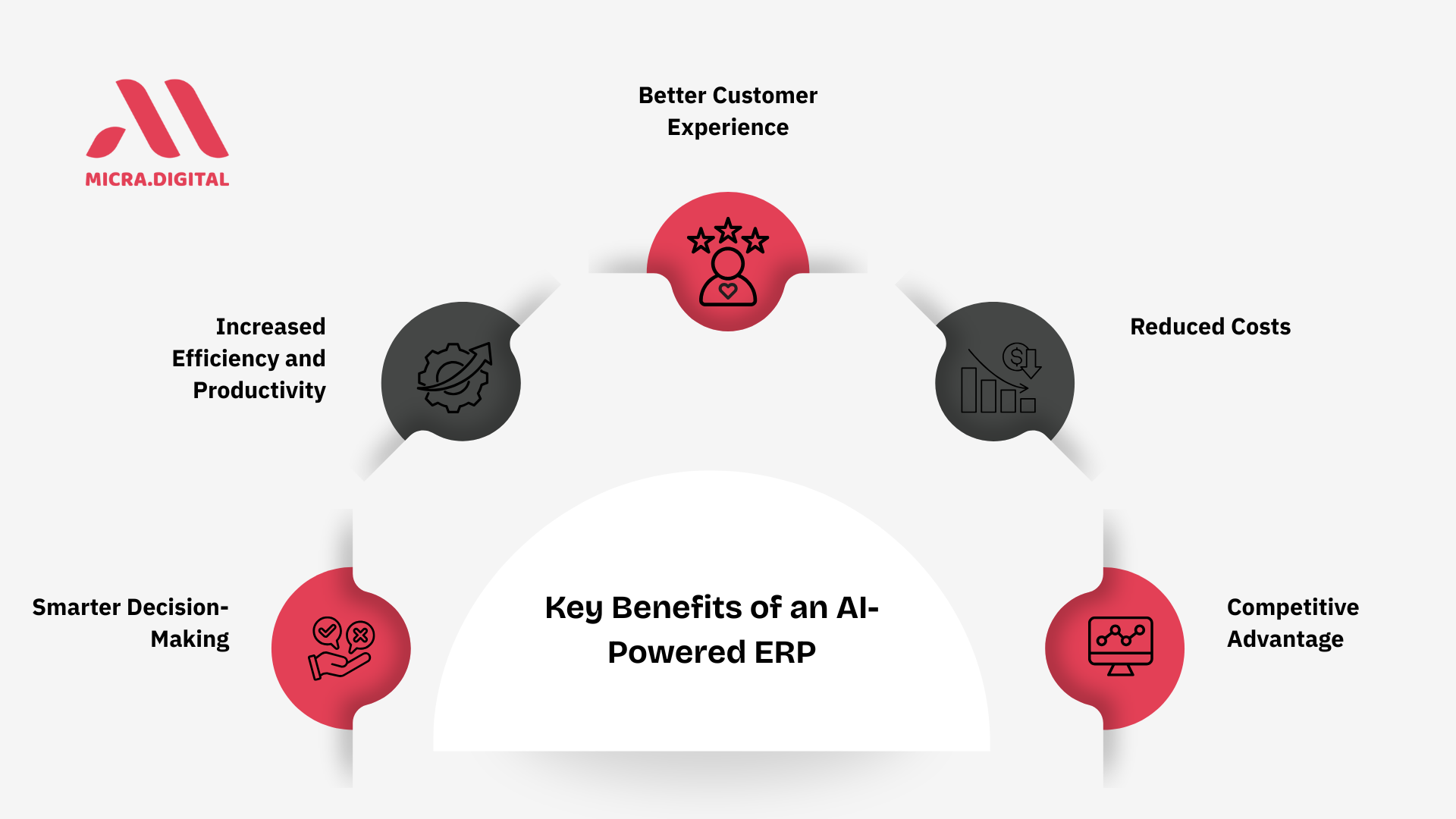
For an ERP system, this means a new way of operating. Instead of just storing data, the AI-powered ERP can:
The combination of a comprehensive ERP and an intelligent AI engine creates a powerful ERP solution that is more than the sum of its parts. This is a key reason why AI is seen as the next step for ERP systems.
Odoo is a complete business management platform. It's an ERP that already has a wide range of apps, from accounting and manufacturing to sales and a website builder. Because all of these apps are connected and share a single database, Odoo is the perfect foundation for AI and ML. When you add AI to the Odoo ERP system, you unlock incredible new possibilities.
In manufacturing, an unexpected machine breakdown can halt production and cost thousands of dollars. A traditional ERP can tell you when a machine broke down and how much it cost. But an AI-powered Odoo ERP can predict the breakdown before it even happens.
In retail, customer loyalty is built on a personal connection. An ERP can tell you what a customer bought. But an AI-powered system can tell you what they are likely to buy next. This is a crucial element of an erp solution.
For a restaurant, knowing what customers love is crucial. An Odoo system can show you your best-selling dishes. An AI-powered ERP can tell you why they are selling well and what other dishes customers would likely enjoy.
In education, a school's main goal is to help its students succeed. A traditional ERP can manage student records and grades. But an AI-powered ERP can predict which students might be struggling. This is a unique application of an ERP solution.
In healthcare, efficient operations are a matter of life and death. An ERP can manage patient records and billing. An AI-powered ERP can help with patient flow and resource management.
This shows that the integration of AI and an ERP is not limited to one industry. It is a fundamental shift in how businesses operate.
The world of business technology is always evolving. For decades, the ERP has been the central nervous system of a company. But today, a new layer of intelligence is being added. The combination of an ERP, AI, and ML is changing how businesses operate. It’s moving them from a reactive model to a proactive one.
For business owners in manufacturing, restaurants, retail, education, and healthcare, this new technology is not just about staying relevant; it’s about building a smarter, more efficient, and more profitable business.
At Micra Digital, we specialize in helping businesses like yours implement and configure an Odoo system that is ready for the future.
Keep ERP access roles tight, log actions, and use vendor best practices. For any AI add-on, ask where data is stored and how it’s used. Your ERP remains your single source of truth.
An AI-powered ERP can help you with a variety of tasks, from predicting customer behavior in retail to forecasting demand in manufacturing. It can give you a deeper understanding of your business and help you make better decisions.
No. While large companies have the resources to invest in complex systems, the increasing availability of affordable software and integrated solutions like Odoo means that small and medium-sized businesses can also use AI for a competitive advantage.
Let Odoo take your business to the next level!
Contact us and take the next step!
Follow Our Adventures!

Ready to launch your next project?
Company
Copyright © 2020. micra.digital. All rights reserved.