- Company
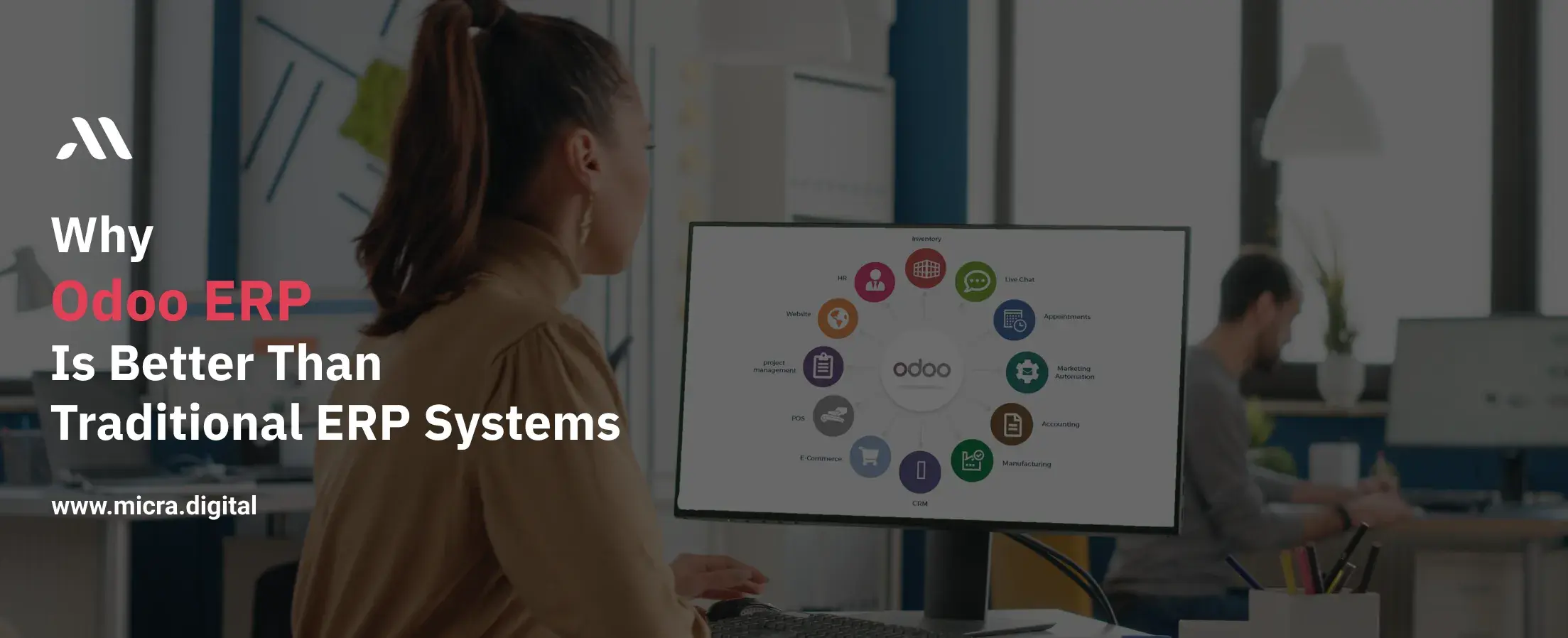
Business owners across industries, whether you're running a manufacturing unit, managing a restaurant, leading a retail chain, handling admissions in education, or operating in healthcare, how you manage your processes can make or break your business.
One of the most common questions business owners ask is:
“Should I go with Odoo ERP or a traditional ERP system?”
If you're asking the same, you’ve come to the right place. In this blog, we’ll help you understand what makes Odoo ERP better than traditional ERP systems. From features to cost, ease of use to flexibility — we’ll cover it all in simple, no-jargon language.
Also Read: Odoo CRM vs Other CRM. Which one is better
ERP stands for Enterprise Resource Planning. It's a system that helps businesses manage everyday activities like inventory, sales, finance, customer relationships, HR, and more — all in one place.
With an ERP, you can reduce manual work, improve team coordination, and get real-time insights into how your business is running.
But not all ERPs are the same. There’s a big difference between modern tools like Odoo ERP and older, traditional ERP systems.
Traditional ERP systems are legacy platforms developed years ago. They’re often used by big corporations and may require heavy customization and long implementation times. Examples include SAP ECC, Oracle E-Business Suite, Microsoft Dynamics (older versions), and others.
These systems typically:
Note: Traditional ERP systems were built for stability and control, not for speed or user-friendliness.
Odoo ERP is a modern, open-source ERP platform that offers a full suite of business apps — from sales and inventory to accounting, HR, CRM, marketing, and more. It’s built to be simple, flexible, and scalable.
Odoo allows businesses to start small and grow at their own pace. Whether you need just a CRM or a full ERP solution, you can choose the apps you need and expand as your business grows.
 (12).jpg)
Let’s break down the major areas where Odoo outshines traditional ERP systems and why it matters for your business.
Traditional ERP Systems:
Odoo ERP:
Tip: For small and mid-sized businesses, Odoo ERP offers unbeatable value for money.
Traditional ERP Systems:
Odoo ERP:
Traditional ERP Systems:
Odoo ERP:
Remember: If your team doesn’t enjoy using the ERP, productivity will drop, no matter how powerful it is.
Traditional ERP Systems:
Odoo ERP:
Traditional ERP Systems:
Odoo ERP:
Tip: With Odoo, you can manage your entire business without jumping between tools.
Traditional ERP Systems:
Odoo ERP:
Traditional ERP Systems:
Odoo ERP:
Note: Whether you have 5 employees or 500, Odoo ERP grows with you.
Traditional ERP systems often create data silos, while Odoo ERP offers:
Note: Businesses using integrated systems see 40% higher productivity (McKinsey).
Both Odoo ERP and traditional ERP systems offer strong security, but:
Remember: Mobile access is crucial for restaurants, retail, and healthcare businesses.
For manufacturing, restaurants, retail, education, and healthcare businesses looking to simplify operations and grow efficiently, Odoo ERP provides the perfect balance of power and usability without the baggage of traditional ERP systems.
Let Micra Digital help you simplify your operations with smart, efficient Odoo ERP solutions. Whether it’s setup, training, or customization, we’ve got your back.
Yes! You can start with just one app and scale as your business grows.
Absolutely. With the right partner, your data can be migrated safely and efficiently.
Community is free and open-source. Enterprise plans offer additional features, support, and hosting.
Depending on your business size and the apps needed, it can go live in a few weeks.
Micra Digital specializes in Odoo implementation, customization, training, and support across industries.
Let Odoo take your business to the next level!
Contact us and take the next step!
Follow Our Adventures!

Ready to launch your next project?
Company
Copyright © 2020. micra.digital. All rights reserved.