- Company
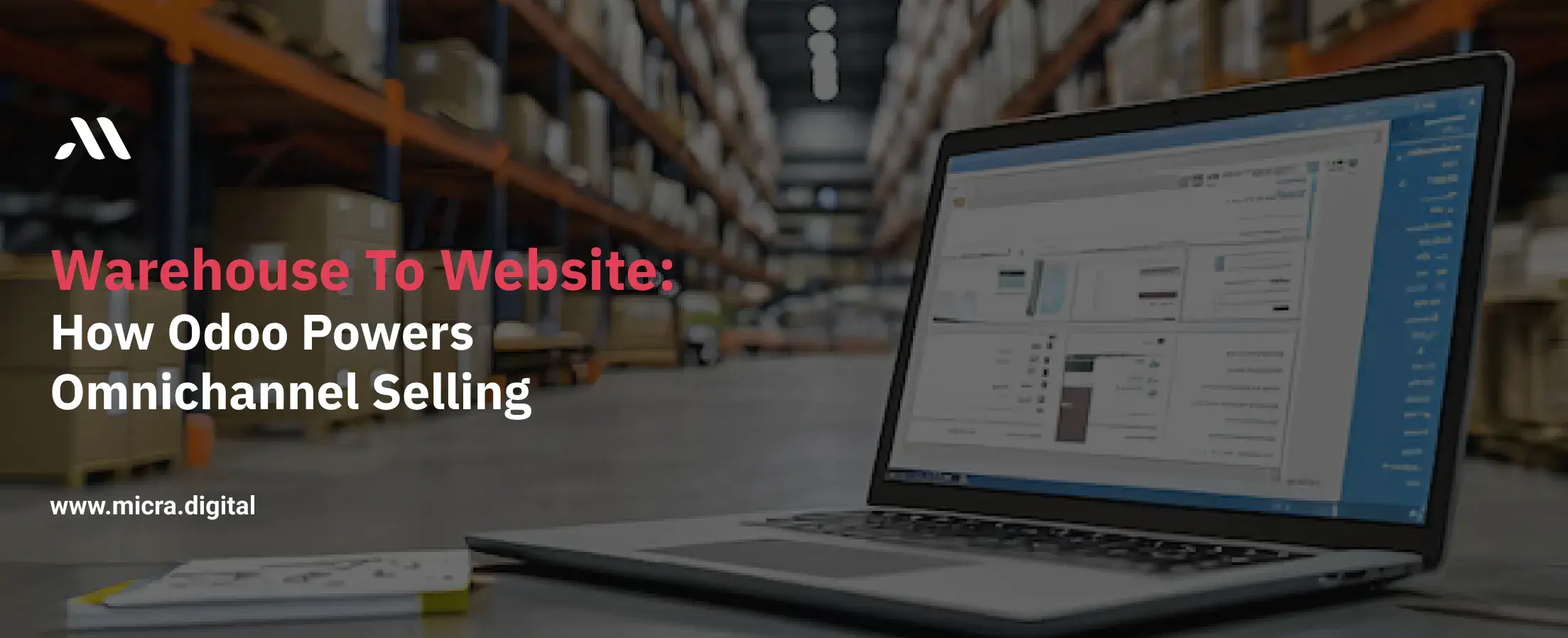
In today's retail world, the customer journey is no longer a straight line. It's a complex web of interactions that may start with a social media ad, lead to a visit to a physical store, and culminate in an online purchase.
This is the reality of omnichannel selling, providing a consistent and connected shopping experience across all channels, whether it's your website, a brick-and-mortar store, a social media shop, or a third-party marketplace.
For businesses, especially those in manufacturing, retail, or even restaurants with a merchandise component, this presents a significant challenge. How do you manage a single inventory that serves multiple sales channels? How do you ensure that when a customer buys a product online, it's instantly removed from the stock available for in-store shoppers?
An ERP system like Odoo breaks down the walls between your inventory, sales, accounting, and e-commerce platforms. It creates a centralized hub where all your business data lives, making it possible to provide a truly seamless omnichannel experience.
This detailed guide will explore how Odoo powers this modern approach to selling, offering practical insights, industry-specific examples, and proven tips for businesses looking to make the leap from fragmented selling to a unified omnichannel powerhouse.
Also Read: Odoo ERP for Non-Tech Teams: Making Every Department Data-Driven
Omnichannel selling means offering customers a unified shopping experience across multiple platforms: physical stores, mobile apps, eCommerce websites, third-party marketplaces like Amazon, and even social media platforms. But it's not just about being everywhere, it's about being connected everywhere.
For example:
Managing this kind of operation requires a powerful, integrated erp solution and that’s exactly what odoo offers.
Many companies try to manage different sales channels using a mix of disconnected tools, one for accounting, another for inventory, another for POS, and so on. The result?
Without a unified enterprise resource planning system, omnichannel selling becomes chaotic. That’s why more and more businesses are turning to Odoo, a modern ERP platform that integrates your entire operation.
.jpg)
Let’s break down how Odoo connects all parts of your business for smooth, efficient, and profitable omnichannel operations.
With Odoo, your inventory across warehouses, retail outlets, and online stores is always synced. Whether you're running a restaurant chain or a large manufacturing unit, Odoo ERP helps you:
Tip: Use Odoo’s barcode scanning feature for faster and more accurate warehouse operations.
Stat: 43% of small businesses either don’t track inventory or use manual methods. This leads to stock issues that cost businesses $1.75 trillion per year globally (Source: IHL Group).
Odoo connects all your sales platforms into one online dashboard online store, POS systems, marketplaces, and internal B2B sales.
You can:
Whether you’re a retail store adding online delivery or a healthcare supplier expanding to Amazon, Odoo software makes selling everywhere simpler.
As soon as a product is packed or shipped, the customer sees it on the website. Thanks to Odoo, your backend warehouse activity is visible to both the business and the customer.
For manufacturing industries where lead times matter, or restaurants offering online orders, this visibility is crucial.
One of the strengths of Odoo ERP is how it consolidates customer information. No matter where a customer orders from your website, physical store, or phone, Odoo builds a central profile.
You can:
This is especially valuable in industries like education and healthcare, where trust and communication play a key role in customer loyalty.
According to Statista, the global ERP market is expected to grow to over $97 billion by 2025. Odoo is one of the fastest-growing platforms, thanks to its real-world usability and strong community.
A truly omnichannel setup also supports easy returns, online or offline. With Odoo, your return policies are applied across platforms, inventory is adjusted automatically, and credit notes or refunds are issued in real time.
This enhances customer satisfaction and simplifies internal processes.
Odoo doesn’t just connect systems, it helps you understand your business with accurate reports and KPIs:
These insights help you make informed decisions, whether you're running a single location or a nationwide brand.
The power of Odoo for omnichannel selling isn't limited to traditional retail. It provides a flexible framework that can be applied to many different business models.
The line between online and offline commerce has blurred forever. Today's customers expect a connected, consistent experience, regardless of how they choose to shop. For business owners, this new reality requires a new approach, one that a powerful ERP system like Odoo makes possible. By providing a single, unified platform that connects your warehouse to your website, your in-store sales to your online marketing, Odoo empowers you to not only meet but exceed these customer expectations.
At Micra Digital, we specialize in helping businesses of all types leverage the full power of Odoo to build a connected, efficient, and profitable omnichannel strategy.
Multi-channel selling is about having multiple sales channels (e.g., a store and a website) that operate independently. Omnichannel selling, however, is about providing a single, unified experience where all channels are connected and work together. The ERP system makes this connection possible.
Yes. Odoo ERP can be integrated with existing e-commerce platforms. While Odoo has its native eCommerce module, it can also connect to other popular platforms, ensuring that your inventory, sales, and customer data are synchronized across all your systems.
No. Odoo is highly scalable and suitable for businesses of all sizes, from a single-store retailer with an online shop to a large chain with multiple locations.
The Odoo Inventory module provides a single, real-time view of your stock. When an item is sold on any channel (e.g., website, POS, or phone order), its quantity is instantly reduced in the central ERP.
The very first step is to get a clear and accurate picture of your current inventory. You need to standardize your product data and get a full count of all your products.
Let Odoo take your business to the next level!
Contact us and take the next step!
Follow Our Adventures!

Ready to launch your next project?
Company
Copyright © 2020. micra.digital. All rights reserved.