- Company
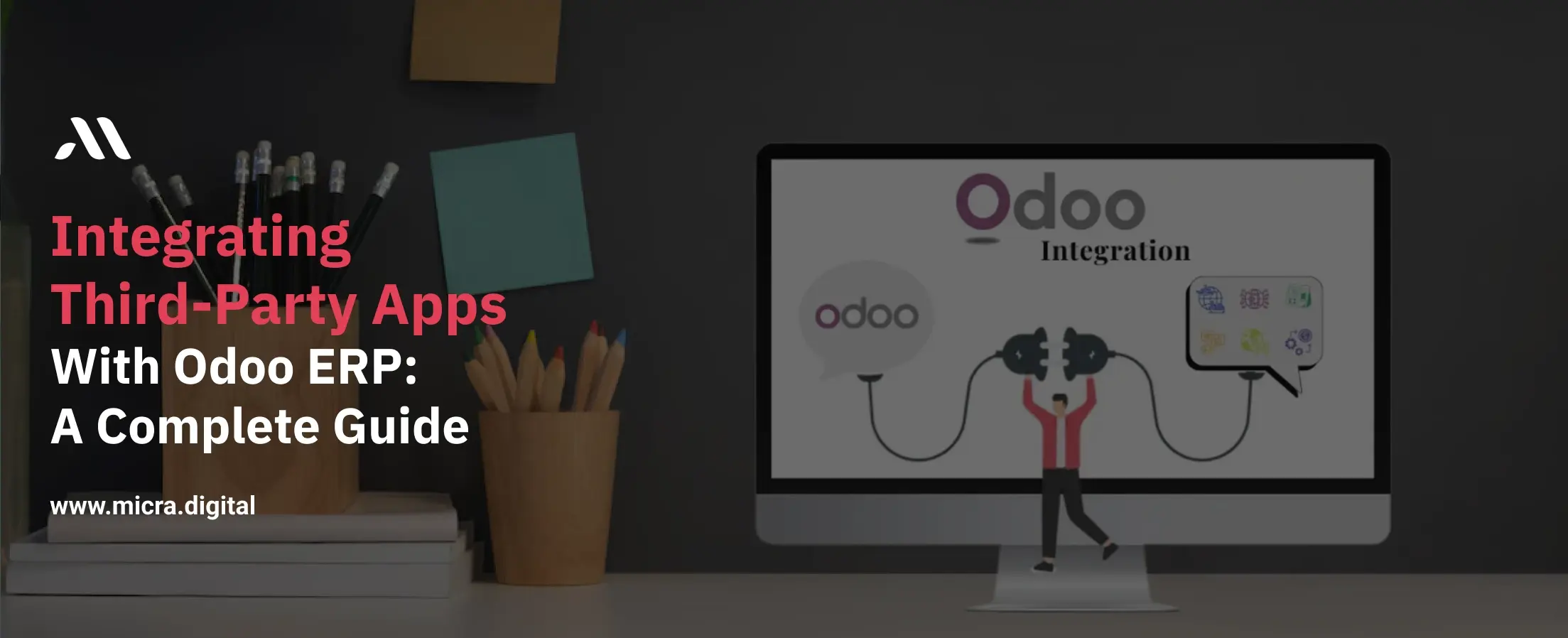
In today's interconnected business world, no single ERP system can meet the needs of every company perfectly.
While Odoo is a remarkably complete ERP software, covering a vast array of business functions from accounting to manufacturing, sales, and HR, there are always specialized needs that can be met more effectively by integrating third-party app solutions.
This detailed blog will dive deep into the world of third-party app integration with Odoo, exploring the significant advantages it offers, the potential challenges you might encounter, and practical use cases across diverse industries.
Also Read: How to manage a business with a mobile phone using Odoo ERP
Despite Odoo’s wide-ranging capabilities, businesses often rely on specialized tools such as payment gateways, e-commerce platforms, communication apps, or logistics providers. Integrating these tools into Odoo helps ensure that your business remains connected, efficient, and adaptable.
The advantages of strategically integrating external applications with your Odoo ERP are numerous:
Odoo provides broad capabilities, but third-party app solutions often offer deep, specialized features that might not be available or as developed within Odoo's standard modules. For instance, a dedicated payroll system might handle complex tax scenarios better, or a specialized shipping aggregator might offer more carrier options and discounted rates.
Example: A retail business might use Odoo for inventory and sales, but integrate with a highly specialized loyalty program software that offers advanced customer segmentation and personalized reward redemption, enhancing the customer experience beyond Odoo's native loyalty features.
76% of businesses report better productivity after integrating third-party tools with ERP systems. (Panorama Consulting)
Integration eliminates manual data entry between systems, which reduces human errors and saves significant time. When data flows automatically, processes become faster and more reliable. This is a core benefit of any good ERP software integration.
Example: In a restaurant, online orders placed through a third-party app delivery platform (like Zomato or Swiggy) can automatically create sales orders in Odoo ERP, update the inventory of ingredients, and trigger kitchen orders, removing the need for staff to manually re-enter orders.
When data is manually transferred between systems, there's always a risk of errors or discrepancies. Integration ensures that data is consistent across all connected platforms. This is critical for accurate reporting, inventory management, and financial reconciliation within your Odoo ERP.
Example: A healthcare provider integrating Odoo with a medical billing system ensures patient demographic and service data are consistent, preventing billing errors and accelerating payment processing.
Companies with e-commerce and ERP integration see 35% faster order processing times. (Aberdeen Group)
With centralized, accurate, and real-time data from all connected systems flowing into your Odoo ERP, managers and owners have a more comprehensive view of their operations. This allows for data-driven decisions based on complete and reliable information.
Example: A school using Odoo with an integrated learning management system (LMS) can pull student performance data into Odoo's reports, allowing for better analysis of educational outcomes and resource allocation.
As your business grows, your needs evolve. Integrating third-party app solutions allows you to add specialized capabilities without overhauling your entire Odoo ERP. This provides immense flexibility and ensures your ERP system can adapt to future demands.
Example: A rapidly expanding retail business might start with Odoo's basic e-commerce, then integrate with a more advanced marketing automation platform as their customer base grows, without needing to change their core Odoo software.
By connecting your Odoo ERP with customer-facing applications (e.g., dedicated e-commerce platforms, customer support ticketing systems), you can provide a more unified and responsive experience.
Example: An Odoo ERP integrated with a specialized customer support helpdesk can ensure that all customer interactions, whether sales or support-related, are visible in one place, leading to faster and more informed resolutions.
.jpg)
Unlike many other ERP software companies, Odoo provides:
This makes Odoo one of the best choices for small, mid-size, and growing businesses looking for an affordable and scalable ERP solution.
Don't settle for a fragmented software landscape. Let Micra Digital help you unlock the full potential of your Odoo ERP by connecting it with the third-party app solutions that drive your business forward. We are committed to helping you establish the best ERP system for your unique requirements.
Check the Odoo App Store or consult with an Odoo implementation expert like Micra Digital.
Yes. Odoo allows multiple integrations, provided they are configured correctly.
With proper testing and backup protocols, the risk is minimal.
Micra Digital can build a custom integration based on your requirements.
If done properly, it won’t. Integrations can speed up workflows and reduce processing time.
Let Odoo take your business to the next level!
Contact us and take the next step!
Follow Our Adventures!

Ready to launch your next project?
Company
Copyright © 2020. micra.digital. All rights reserved.