- Company
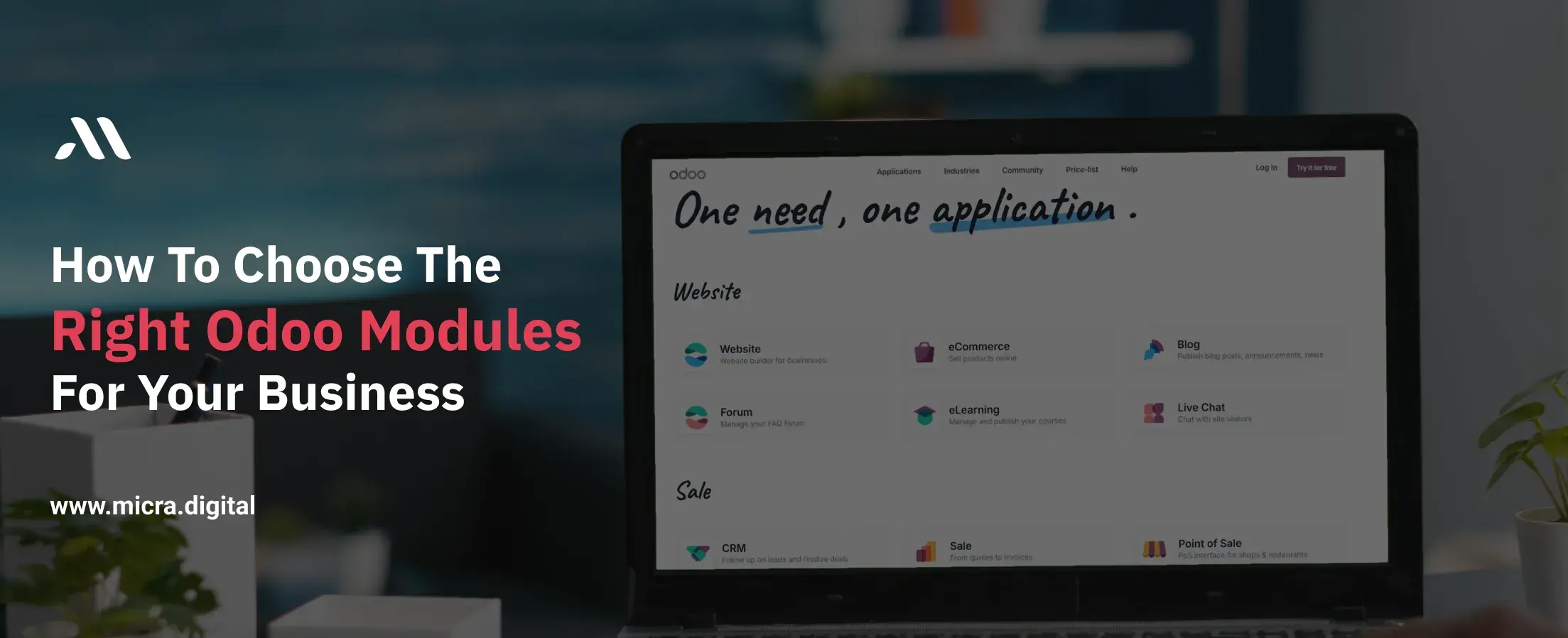
Selecting the right Odoo modules is a critical step in any successful ERP system implementation. Think of Odoo as a vast toolkit, with each module being a specialized tool designed for a specific business function, from sales and inventory to accounting and human resources.
The power of Odoo lies in its modularity, allowing businesses to pick and choose exactly what they need, avoiding unnecessary complexity and costs. However, with over 70 official modules and thousands more in the community app store, the choice can feel overwhelming.
This in-depth blog will guide you through the process of choosing the most appropriate Odoo modules for your specific business needs.
Also Read: Odoo for Startups: Why Early Adoption Pays Off
Before you even look at a single Odoo module, the most crucial step is to thoroughly understand your own business processes, pain points, and future goals. This foundational analysis is often overlooked, leading to mismatched ERP software selection and ultimately, dissatisfaction with the ERP system.
Conduct an in-depth "as-is" and "to-be" business process analysis. Map out how your operations currently work (as-is) and then envision how you want them to work with an ERP solution (to-be).
Involve key employees from every department. They are the ones who truly understand the daily operational challenges and can provide invaluable insights into what functionalities are essential for a new Odoo system.
What are our biggest operational bottlenecks? (e.g., slow order processing, inaccurate inventory, difficult financial reporting)
Where do we experience the most human errors?
Which departments struggle with data sharing or communication?
What are our immediate growth plans? (e.g., expanding product lines, opening new locations, launching an online store)
What information do we need to make better business decisions?
What are our long-term strategic goals (e.g., reducing production costs, improving customer retention, gaining better control over finances)?
.jpg)
Regardless of your industry, several Odoo modules form the core of most ERP system implementations. These are the fundamental building blocks of any business.
1. Sales: Manages your sales pipeline, quotations, sales orders, and customer invoicing. Essential for tracking revenue and customer interactions.
Relevance: Every business needs to manage sales efficiently.
2. Inventory:Tracks product stock levels, manages warehouses, stock movements, and inventory valuation. Crucial for understanding what you have, where it is, and its value.
Relevance: Essential for any business that sells physical products (manufacturing, retail, restaurants, even some healthcare providers with supplies).
3. Accounting: Handles all financial transactions, including invoicing, vendor bills, bank reconciliation, budgeting, and financial reporting (Profit & Loss, Balance Sheet).
Relevance: Non-negotiable for every business. Accurate financial data is the backbone of any ERP solution.
4. Purchase: Manages procurement, vendor relationships, purchase orders, and goods receipts.
Relevance: Important for any business that buys goods or services from suppliers.
5. CRM (Customer Relationship Management): Helps manage leads, opportunities, customer communications, and customer service.
Relevance: Critical for nurturing customer relationships and driving sales growth in any business.
6. Website & eCommerce: For businesses looking to establish or enhance their online presence, selling products or services directly from an integrated website.
Relevance: Increasingly important for retail, education (online courses), and even some manufacturing businesses for direct sales.
These core Odoo modules provide the basic framework for an enterprise resource planning system. Most ERP software companies will recommend starting with these and then building outwards.
While the core modules are universal, Odoo's true power for diverse industries in Rajkot comes from its specialized applications. Here’s how specific modules cater to the unique needs of different sectors:
Manufacturing businesses require precise control over production, inventory, and supply chains.
Manufacturing (MRP): This is paramount. It handles Bill of Materials (BOM), work orders, production planning, work center management, and quality control. It is integral for efficient production planning and control within your Odoo ERP.
Inventory:Directly integrates with MRP to track raw materials, work-in-progress, and finished goods.
Purchase: For sourcing raw materials and components.
Sales: For managing customer orders and forecasting demand.
Quality:Ensures product quality control at various stages of production.
Maintenance:Helps schedule and manage equipment maintenance, reducing downtime.
PLM (Product Lifecycle Management): For managing product versions, engineering changes, and documentation, especially for complex products.
Note: Manufacturing businesses often see significant gains in efficiency (up to 22% operational efficiency increase for those implementing ERP modules (Source: Bharuwa Solutions) by integrating their ERP system with their production lines.
Restaurants need to manage quick sales, fluctuating inventory, and staff effectively.
Point of Sale (POS): Crucial for managing orders, tables, bill splitting, and payments at the counter or tableside. An intuitive POS is the heart of a restaurant's ERP solution.
Inventory: For tracking ingredients, managing recipes (BOMs for dishes), and reducing food waste. This directly impacts food costs and profitability in your Odoo system.
Purchase: For ordering supplies and ingredients from vendors.
Accounting:For managing sales, expenses, and payroll.
Employees & Timesheets:For managing staff schedules and tracking labor costs.
CRM: For managing customer loyalty programs and feedback.
Retailers need to manage sales across multiple channels, inventory, and customer relationships.
Point of Sale (POS): For in-store sales, managing products, prices, and payments.
eCommerce: If you sell online, this module integrates your online store directly with your inventory and sales. It creates an omnichannel experience with your Odoo ERP.
Inventory: Manages stock across multiple locations (stores, warehouse) and tracks product movement. Essential for avoiding overselling or stock-outs.
Sales: For managing customer orders, returns, and quotations.
CRM:For managing customer loyalty programs, customer feedback, and targeted marketing campaigns.
Purchase:For managing supplier orders and replenishing stock.
Marketing (Email Marketing, Marketing Automation): For engaging customers with promotions and newsletters.
Educational institutions need to manage admissions, courses, student records, and fees.
Sales (for Admissions/Enrollment): Can be configured to manage the application and admission process.
Accounting: For managing tuition fees, payments, expenses, and payroll.
HR (Employees, Time Off, Payroll): For managing faculty and staff records, attendance, and leave.
Project (for Course/Curriculum Management): Can be adapted to manage course creation, curriculum planning, and assignment tracking.
Website: For creating an institutional website, course catalog, and potentially online application portals.
CRM:For managing inquiries from prospective students and communicating with parents.
Dedicated Education Management Modules (Community/Third-Party): While Odoo has core modules, there are many specialized Odoo software extensions available that provide features like student portals, attendance tracking, grade management, and timetable scheduling.
Healthcare businesses require careful management of appointments, patient records, billing, and inventory of medical supplies.
Appointments/Calendar: For scheduling patient appointments and managing doctors' availability.
Sales (for Services/Billing): Can be used for creating service orders and patient invoices.
Accounting: For managing billing, insurance claims, payments, and financial reporting.
Inventory: For tracking medical supplies, medications, and equipment.
CRM: For managing patient inquiries, follow-ups, and patient history.
HR (Employees, Payroll): For managing medical staff, nurses, and administrative personnel.
Project (for specific patient cases/treatments): Can be used for managing complex treatment plans or long-term care cases.
Dedicated Healthcare Management Modules (Community/Third-Party): There are specialized Odoo software modules that cater to patient records, prescriptions, and lab integrations, though these may require careful evaluation for specific regulatory compliance and data security needs, which are paramount in healthcare for any ERP system.
Choosing the right Odoo modules for your business is a strategic decision that can truly empower your growth.
Whether you're a manufacturing powerhouse aiming for production optimization, a restaurant seeking efficient order management, a retail store needing omnichannel capabilities, an educational institution improving administrative tasks, or a healthcare provider enhancing patient services, Odoo offers an ERP solution that can be precisely matched to your needs.
Let Micra Digital help you choose the right combination for maximum efficiency and growth.
Yes. Begin with core modules and expand as you stabilize processes.
Absolutely. Odoo’s modular design allows easy additions.
Track key metrics (order cycle time, manual tasks eliminated) within 3–6 months of activation.
Use only from reputable Odoo app stores with verified reviews and responsive publishers.
Odoo Community is the free, open-source version, offering core functionalities. Odoo Enterprise is the paid version, providing additional features
Let Odoo take your business to the next level!
Contact us and take the next step!
Follow Our Adventures!

Ready to launch your next project?
Company
Copyright © 2020. micra.digital. All rights reserved.