- Company
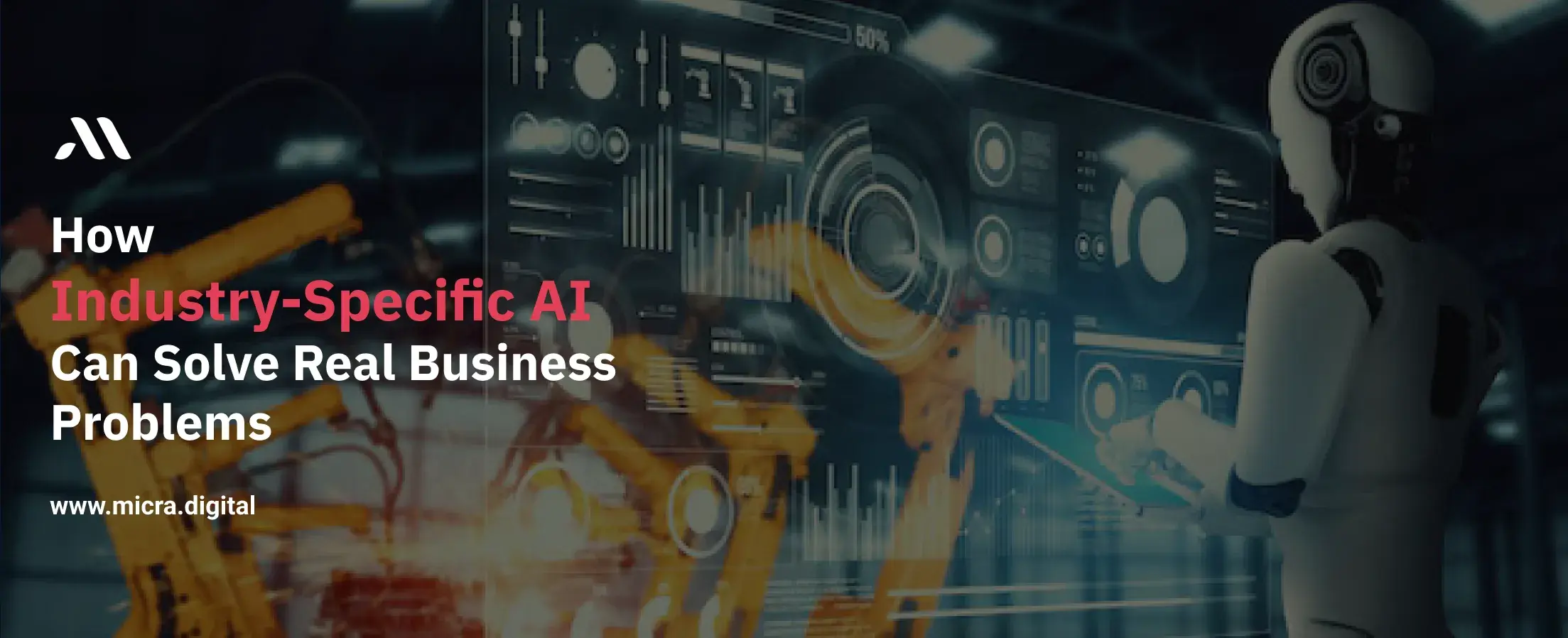
The buzz around Artificial Intelligence (AI) and Machine Learning (ML) has reached a fever pitch, with discussions ranging from futuristic robots to self-driving cars.
While these advancements are exciting, for many business owners, especially those in traditional sectors like manufacturing, retail, education, healthcare, and restaurants, the question remains: "How can AI agents solve my real-world business problems?"
The answer lies not in generic AI agent solutions but in industry-specific AI agent applications, where AI agents and ML are tailored to address the unique challenges and opportunities within a particular sector.
This detailed blog will delve into how industry-specific AI agents are transforming business operations and providing tangible benefits across diverse industries
Also Read: The Role of Odoo ERP in Digital Transformation for SMEs
While general AI agent models, like large language models, offer broad capabilities, their effectiveness in solving precise business problems can be limited. They lack the deep contextual understanding and specialized data required to address nuanced industry challenges. This is where an industry-specific AI agent steps in.
Industry-specific AI agent uses vast amounts of data specific to a particular sector, be it historical sales data from a retail chain, sensor data from manufacturing machinery, patient records in healthcare, or student performance data in education.
By training machine learning models on this specialized data, AI agents can develop highly accurate predictions, automated processes, and insightful recommendations that are directly relevant to the industry's unique demands. This allows an AI agent for business to be truly impactful.
Think of it this way: a general-purpose screwdriver is useful for many tasks, but a customized set of tools, each designed for a specific type of screw or intricate mechanism, will perform far better in a specialized repair job. Similarly, an industry-specific AI agent provides the precise tools needed to solve specific business problems. The power of an AI agent truly shines when it's focused.
The global AI agent market is expected to reach over $1.8 trillion by 2030, indicating massive investment and adoption. (Source: faistgroup)
Let's explore practical applications of AI agents and ML in various industries:
Manufacturing is ripe for AI agent adoption, with applications spanning the entire production lifecycle. AI agents can significantly improve efficiency, reduce waste, and enhance product quality.
Problem Solved: Unplanned downtime, costly emergency repairs, production delays, and reduced lifespan of expensive machinery.
Problem Solved: Substandard products reaching customers, wasted materials from defects, and high labor costs for manual inspection.
Problem Solved: Overstocking (leading to storage costs and waste), understocking (leading to lost sales and customer dissatisfaction), inefficient logistics.
Problem Solved: Long design cycles, limited exploration of design possibilities, and high prototyping costs.
94% of businesses report improved productivity after AI agent adoption (Source: Accenture)
The restaurant industry is fast-paced and depends heavily on customer satisfaction and efficient operations. AI agents can provide significant advantages.
Problem Solved: Food spoilage, running out of popular ingredients, and over-ordering.
Problem Solved: Generic marketing, missed upselling opportunities, inconsistent customer service.
Problem Solved: Long wait times for phone orders, staff overload during peak hours, basic customer inquiries tying up human resources.
Problem Solved: Lost revenue during off-peak hours, inability to respond to competitor pricing quickly.
Retail is highly competitive, and AI agents are revolutionizing how businesses interact with customers, manage inventory, and optimize pricing.
Problem Solved: Generic recommendations, customers struggling to find relevant products, and low conversion rates.
Problem Solved: Stockouts, excessive dead stock, inefficient use of retail space.
Problem Solved: Credit card fraud, return fraud, employee theft.
Problem Solved: Suboptimal pricing, ineffective promotional campaigns.
AI agent in education is not about replacing teachers but empowering them and personalizing the learning experience.
Problem Solved: One-size-fits-all education, students falling behind or getting bored, difficulty identifying learning gaps.
Problem Solved: Time-consuming manual grading, delayed feedback to students, inconsistencies in evaluation.
Problem Solved: Students dropping out, academic struggles going unnoticed until it's too late.
Problem Solved: Limited access to tutors, students struggling with concepts outside of class hours.
AI agents are poised to revolutionize healthcare, from diagnostics to drug discovery and administrative tasks.
Problem Solved: Human error in interpreting scans, lengthy diagnostic processes, and missed early detection.
Problem Solved: Generic treatment approaches, suboptimal patient responses.
Problem Solved: High administrative costs, staff burnout from paperwork, delays in billing and scheduling.
Problem Solved: Extremely long and expensive drug discovery processes, low success rates.
Industry-specific AI agents and ML are not sci-fi; they’re real tools delivering real results today. Whether you operate a factory, a restaurant, a retail chain, a school, or a clinic, adopting an AI agent for business solves immediate problems and builds a smarter, more efficient future.
From predictive maintenance to personalized learning paths, diagnostic support to smart inventory, there’s an AI agent solution for every use case. The key is starting small, learning fast, and scaling since every effort delivers better insights and smoother business operations.
Ready to unlock that potential? Talk to us at Micra Digital and let’s turn an AI agent into your most powerful team member.
Not always. Solutions can be scoped to specific, high-impact use cases that pay for themselves quickly.
Basic pilots can deliver value in a few weeks. Full deployments take 3–6 months.
Using the evaluation tool, we can measure the accuracy of the output.
No. AI agent automates repetitive work and empower humans to do higher-value tasks.
Let Odoo take your business to the next level!
Contact us and take the next step!
Follow Our Adventures!

Ready to launch your next project?

Company
Copyright © 2020. micra.digital. All rights reserved.